
Sofia Airport is a short way out from the middle of the city, and Terminal 2 has a metro station attached to the end of it. We landed on a Saturday in January 2026, walked out of arrivals and were standing in the centre of town twelve stops later, having spent less than a euro each. Low-cost flights still come into Terminal 1, which means a free shuttle bus first, but the principle holds: the capital of a ski country puts its arrivals hall on the underground.
Sofia is a city break with mountains attached rather than a ski resort with a city attached, and the three ski areas within reach of it are very different propositions.
Vitosha: the mountain inside the city
Vitosha rises straight off the southern edge of the built-up area, and the Aleko hut at the top of the ski terrain sits at 1,810 m. On paper there is around 20 km of mostly easy piste, running from roughly 1,530 m to 2,270 m.
On the ground, the lifts are a long-running local sore point. The Simeonovo gondola — the one that used to lift people from a city bus stop to Aleko — stopped without warning days after the season opened at the end of 2023. Its owner later confirmed it would not return, blaming spare parts the original manufacturer no longer supplies. The Dragalevtsi chairlift below it has been listed as out of service too, and the two small Vitoshko Lale lifts at the top closed for maintenance at the end of September 2026, with mid-December mentioned as a hope rather than a date.
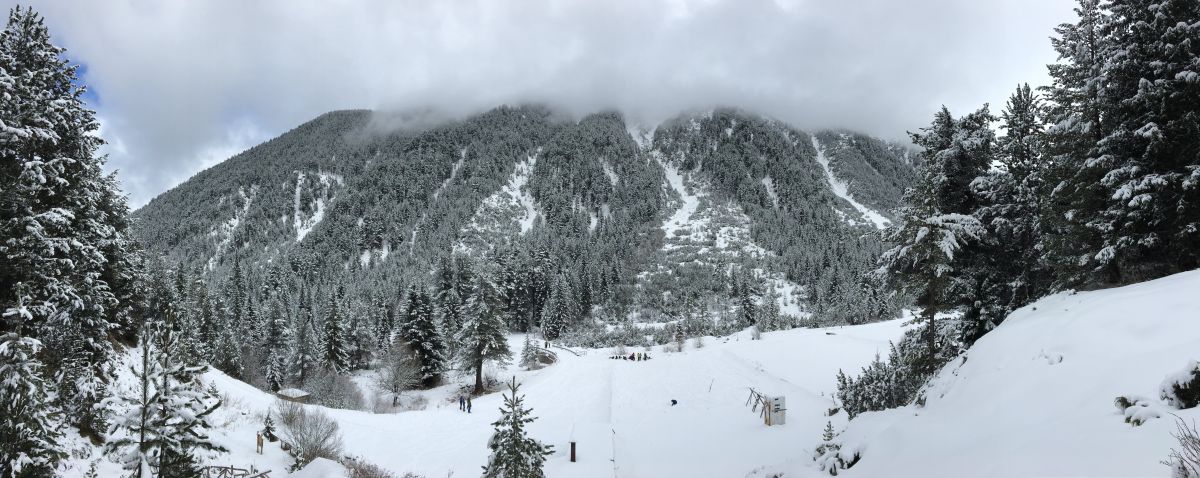
So Vitosha is genuinely reachable on public transport — bus 66 climbs from the zoo, or from Vitosha station on the M2 line, all the way to the hut — and genuinely not a reliable lift-served ski day. We went up twice, once on skis and once on foot, and the second time was better.
Borovets, an hour down the Samokov road
Borovets is the one that makes a day trip work. It is about 70 km south-east of Sofia, and the run out along the ring road and the Samokov highway took us a shade over an hour. It marked its 130th birthday in December 2025 and skis like a forest resort, with runs cut through pine and a top station at Markudjik around 2,486 m against a base near 1,350 m.
Twelve lifts and thirty-one marked slopes is a decent spread for a day. Early-bird adult day passes for 2026/27 were advertised a little under €57, with half-days in the €40 to €46 range. The lifts have been starting around the very end of December in recent years, so a mid-December trip is a gamble on snowmaking.
Bansko, and the two hours to reach it
Bansko is the serious one, and the distance is the price of that. It is roughly 163 km from Sofia, which the resort rounds to about two hours by car. The route runs south on the A3 Struma motorway to the Simitli exit, then east over the Predel pass at about 1,140 m before dropping into the Razlog valley. The pass is the part that matters: two lanes of gradient, and the first place the weather shows up. Bulgaria requires tyres suitable for winter conditions, or at least 4 mm of tread, from 15 November to 1 March.
The reward is the biggest lift-served mountain in the country — fourteen lifts, fifteen pisted runs and a couple of ski roads, with a published season from 1 December 2026 to 11 April 2027. The gondola runs 08:30 to 17:00 and the lifts above it stop at 16:15, which is worth knowing before a long last descent.
| Resort | From Sofia | Driving time | Lifts |
| Vitosha (Aleko) | City edge; bus 66 | Under an hour | Partly closed; check |
| Borovets | About 70 km | Just over an hour | 12 |
| Bansko | About 163 km | About two hours | 14 |
Pamporovo, the fourth name on the Bulgarian ski map, is the one we wrote off before arriving: 223 km and about three hours from the capital, which makes it a holiday in its own right rather than a day out of Sofia.
Reaching Bansko without a car is the awkward part. The scheduled coach takes nearer three hours than two, and the bus to Bansko leaves from Sofia’s central bus station rather than the airport, which means crossing the city with skis before the trip has even started. We decided to arrange a driver from Sofia to Bansko instead and treat the two hours as part of the holiday rather than the price of it. Taxi 4 Travel covered that leg. The one snag was the meeting point — Terminal 2 arrivals in January is a scrum, and it took us a few minutes to find each other.
What the city does in winter
Sofia in January sits around 3°C by day and below freezing most nights, which is cold enough to be atmospheric and not cold enough to be a problem. Several things we did would have been worse in summer.
- The mineral taps. Beside the yellow Central Mineral Baths and the Banya Bashi mosque, roughly thirty public taps run hot thermal water day and night, free to anyone. People queue with five-litre bottles, and on a cold morning the corner steams.
- Serdica under the pavement. The Roman street grid turned up during metro construction and was kept: paving, walls and foundations sit in a sunken complex at Serdika station, so the archaeology is on the way to the train.
- Saint Alexander Nevsky. Enormous, and better in snow than in sun. The crypt beneath it is a branch of the national gallery and holds Bulgarian icons spanning centuries; open Tuesday to Sunday, 10:00 to 18:00.
- The antiques stalls. Fifteen or twenty pitches on the cathedral square sell Soviet badges, medals, old photographs and hand-knitted socks. The bigger weekend market out at Malashevtsi, Saturday and Sunday mornings, is a different animal — car parts and radios laid out on the ground.
- The Central Market Hall. Reopened in 2024 after a year of building work, now part food market, part performance space.
The performing arts are also startlingly cheap. Two decent theatre seats in Sofia were costing in the region of €28 together in 2026, which makes a Tuesday-night opera a casual decision rather than an event.
The air
On still, cold, cloudless days Sofia sits in a basin under an inversion and the smoke from domestic heating has nowhere to go. Bulgaria has repeatedly recorded the worst particulate pollution in the EU, and the capital’s winter readings have at times run well above the limit values. Two of our mornings were hazy at street level with a clear sky from the top of Vitosha — an argument for spending the murkiest days high and the clear ones in town, the opposite of how most people plan a city break.
What We’d Change
We would stop treating Vitosha as a ski option and treat it as a walk. The lift dispute has been unresolved for years, and as a way to get above the smog on foot, with a bus at either end, the mountain is excellent regardless.
We would also split the week differently. Five nights in Sofia with Bansko as a single long day was the wrong way round: the drive is pleasant once and tiring twice in the dark. Two nights in Bansko and four in the city would have given the mountain a fair hearing and still left room for the markets, the crypt and a half-empty concert hall. And we would agree a meeting point at the airport by door number rather than by terminal.
