

Hidden beneath mountains, carved by underground rivers or sculpted by centuries of ice, caves can reveal entire worlds of their own. From the immense chambers of Vietnam’s Hang Son Doong to the glowing blue passages of New Zealand’s Waitomo Caves and the marble formations of Chilean Patagonia, here are 10 strikingly beautiful caves around the world.
#1. Hang Son Doong Cave, Vietnam
Hang Son Doong cave is located in Quang Binh province, Vietnam and is currently known as the largest cave in the world. It is said that the cave was discovered in 1991 by a local man named Ho Khanh, but nobody dared to explore it until 2009, when the British cavers ventured inside.

Hang Son Doong is 200 meters wide, 150 meters high, and about 9 kilometers long.
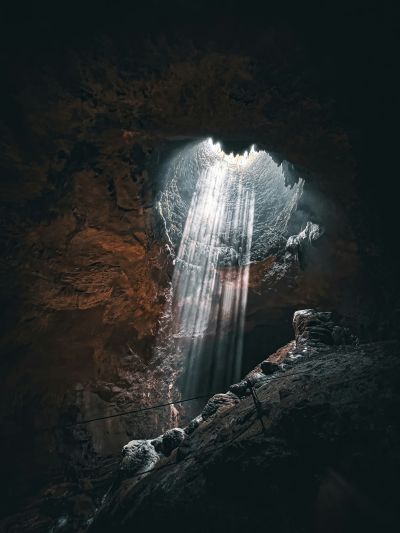 One of the most remarkable features of Hang Son Doong is its extraordinary underground ecosystem. Two sections of the cave ceiling have collapsed over time, creating enormous natural skylights known as dolines. Sunlight and rain enter through these openings, allowing a tropical forest of trees, palms and ferns to grow deep beneath the surface. The cave also contains an underground river, which has helped shape its vast chambers over millions of years.
Exploring Hang Son Doong is an expedition rather than a conventional sightseeing trip.The cave lies deep within Phong Nha-Ke Bang National Park, surrounded by dense tropical forest and ancient limestone mountains. The nearest major city is Dong Hoi, approximately 45–70 kilometres away, depending on the route. Visitors usually travel first to Phong Nha village, which serves as the starting point for organised cave expeditions. Reaching the cave itself requires a challenging trek through the jungle and neighbouring cave systems.
Hang Son Doong can only be visited through organised, specialist expeditions, with a limited number of visitors admitted each year to protect its fragile environment. The journey involves several days of trekking through dense jungle, crossing rivers, navigating enormous boulders and camping inside the cave itself.
#2. Mendenhall Ice Caves, Juneau, Alaska
According to TravelJuneau.com, Mendenhall Glacier is approximately 13 miles (21 kilometres) long and flows from the vast Juneau Icefield towards Mendenhall Lake. It is part of the Tongass National Forest, one of the largest temperate rainforests in the world. The surrounding landscape is a fascinating combination of ancient ice, dense evergreen forests, waterfalls and rugged mountain peaks. One of the highlights of the area is Nugget Falls, a spectacular waterfall cascading down a rocky mountainside near the glacier. Visitors can reach it via a scenic walking trail offering impressive views of the lake and floating icebergs.
The glacier has been retreating for decades, gradually revealing landscapes that were once buried beneath thick layers of ice. Its changing appearance is a visible reminder of the effects of climate change on Alaska’s glaciers.

Mendenhall Glacier has a total length of 12 miles, extending between Juneau Icefield and Mendenhall Lake. Commercial operators offer tours in the summer, including hiking, biking, rafting, canoe and kayak trips, and bus, van, taxi and shuttle tours.
Visitors can explore the area through several hiking trails, take guided kayak or canoe excursions on Mendenhall Lake, or book helicopter tours offering aerial views of the Juneau Icefield. The Mendenhall Glacier Visitor Center also provides exhibitions and educational information about glacial movement, local wildlife and the surrounding ecosystem. Although the famous blue ice caves have attracted photographers and adventurers for years, they are extremely unstable and dangerous to enter. Their appearance changes constantly, and visitors should admire the glacier from designated viewing areas or join authorised guided activities
#3. Waitomo Glowworm Caves, New Zealand
New Zealand is full of surprises, whether we are talking about culture, art or nature. Waitomo Glowworm Caves are just another pleasant surprise, and definetly a must see for each of us.

Waitomo region is part of the North Island of New Zealand, and it is exclusively known for its population of glowworms. They are known as Arachnocampa luminosa and their habitat is very well preserved (since they only exist in New Zealand) by a special Scientific Advisory Group.
Despite their name, they are not actually worms but the bioluminescent larvae of a fungus gnat. They produce a blue-green light through a chemical reaction in their bodies, using it to attract small flying insects. Hanging from the cave ceilings, the larvae create long, delicate silk threads covered in sticky droplets, which act as traps for their unsuspecting prey. Thousands of these tiny lights scattered across the darkness create the impression of a star-filled night sky beneath the earth.

The Waitomo Glowworm Caves were first explored in 1887 by local Māori chief Tane Tinorau and English surveyor Fred Mace, and have attracted visitors for well over a century.
Guests can discover the cave through a quiet boat ride along the underground Waitomo River, allowing visitors to admire the glowing ceiling without disturbing the delicate environment. The silence is an essential part of the experience, as artificial light and noise can affect the glowworms. The caves are also part of a wider limestone landscape featuring underground rivers, impressive rock formations and several interconnected cave systems. Guided tours are available throughout the year, and advance reservations are recommended, particularly during busy travel periods.
To protect this delicate underground ecosystem, the caves are carefully monitored by conservation specialists. Temperature, humidity, air quality and carbon dioxide levels are regularly measured to ensure that visitor numbers and tour conditions do not disturb the glowworms or their habitat. Access is therefore organised through guided tours, with group sizes and visiting conditions managed to minimise the impact on the environment.
If you are planning a visit, booking your tour in advance is highly recommended, especially during the summer holidays and peak travel seasons.
4. The Eisriesenwelt Ice Cave, Austria
In English, Eisriesenwelt means World of the Ice Giants, hinting that winter lovers will be more than happy to visit this special place. Situated in Werfen, Austria, the Eisriesenwelt Ice Cave is currently the largest ice cave in the world, with its more than 42 km in length.

What makes Eisriesenwelt particularly fascinating is the way its ice formations have developed over thousands of years. Meltwater enters the cave through cracks and openings in the limestone, freezing when it encounters the cold air inside. Over time, this process creates enormous ice walls, frozen waterfalls, columns and delicate crystalline structures. Some of the most impressive formations have been given imaginative names, such as the Ice Palace and the Great Ice Embankment. The cave maintains temperatures around 0°C, even during the summer months, making it a remarkable natural contrast to the warm mountain landscape outside.
The cave was discovered in 1879 by a scientist from Salzburg named Anton Posselt. Visitors arrived only after 1920, and today nearly 200.000 tourists leave this place with flushed cheeks and smiles on their faces.
Although the entire cave system stretches for more than 42 kilometres, visitors explore approximately one kilometre of its spectacular ice-covered passages on a guided tour. The experience involves climbing around 1,400 steps and gaining approximately 134 metres in elevation. One of the most memorable aspects of the visit is the traditional way the guides illuminate the ice formations using lamps and magnesium light, revealing their extraordinary shapes and textures against the darkness. Photography is not permitted inside, so visitors are encouraged to enjoy the experience rather than document it.
Reaching the cave is an adventure in itself. From the visitor centre, visitors walk to the cable car station, take a short ride up the mountain and then continue on foot along a panoramic trail to the entrance, situated at approximately 1,641 metres above sea level. The entire visit takes around three hours, including the approach and guided tour. Eisriesenwelt is generally open from May until early November, depending on the season and weather conditions. Advance online booking is recommended, as visitor capacity is limited.
If you happen to be in Salzburg, we advice you not to miss the opportunity to visit this marvelous cave, considering that there are only 40 km that separates you from this heaven of ice. Don`t forget to bring warm clothes, gloves and winter shoes!
#5. Marble Cathedral of Chile
 If you have not traveled to Chile before, we might give you a reason to go there (and many more to come in the future posts). The Marble Cathedral, also known as Capillas de Mármol, is part of a spectacular network of marble formations along the shores of General Carrera Lake, one of the largest lakes in South America. These extraordinary structures have been shaped by water erosion over thousands of years, gradually carving smooth walls, arches, tunnels and caverns into the marble peninsula. The rock itself displays beautiful shades of white, grey, blue and pink, creating an almost abstract pattern that becomes even more striking when reflected in the turquoise waters of the lake.

Depending on the weather, water level and time of day, the marble caverns offer a spectacular color game in a constant change, so your experience will never be the same, even if you travel there several times.
The most famous formations include the Marbel Cathedral , Marble Chapel and Marble Caves, each offering a different perspective on this remarkable geological landscape.

The best way to explore the formations is by boat or kayak from Puerto Río Tranquilo, a small settlement along Chile’s Carretera Austral in the Aysén region of Patagonia. Boat excursions take visitors close to the marble walls and, when water conditions allow, through some of the natural arches and passages. The experience is particularly memorable on calm days, when the lake acts like a mirror and the intricate patterns of the rock are reflected across its surface.
#6. Devetashka Cave, Bulgaria
Extending approximately 2.4 kilometres, Devetashka Cave covers an area of more than 20,000 square metres and reaches heights of around 60 metres in some sections. Its most recognisable feature is the series of 7 large openings in the ceiling, locally known as Oknata, meaning “The Eyes”. These natural skylights allow daylight to penetrate deep into the cavern, creating an unusual landscape where vegetation grows alongside towering limestone walls and rocky formations.

Did you know that Devetashka cave used to be inhabited (with some interruptions) during almost every historical era? The earliest traces of human presence date back to the middle of the Early Stone Age. Its enormous chambers provided shelter to human communities over thousands of years, making the cave an important archaeological site for understanding the history of settlement in the region.
The cave is also an important natural habitat, particularly for bats. Several species use its dark chambers as a refuge and breeding ground, making conservation an essential part of managing visitor access. The surrounding area belongs to the protected Devetashko Plateau, known for its rich biodiversity and limestone landscapes. Located near the village of Devetaki, approximately 18 kilometres from Lovech, the cave is an interesting stop for travellers exploring northern Bulgaria.

#7. Fingal`s Cave, Scotland
Scotland never failed us in terms of culture and tourism, and it looks like we are not the only ones who marvel at its natural treasures.
Fingal’s Cave is one of Scotland’s most extraordinary natural landmarks, formed almost entirely from regular hexagonal columns of volcanic basalt. These remarkable formations were created around 60 million years ago, when ancient lava flows cooled and contracted, producing the geometric patterns that can still be admired along the island’s coastline. Over time, the relentless movement of the Atlantic Ocean carved an enormous sea cave into the basalt cliffs, creating a dramatic natural entrance that resembles the interior of a cathedral.

The cave is hosted by the uninhabitated island of Staffa, property of the National Trust for Scotland and measures 72 feet tall (22 metres) and 270 feet (82,3 meters) deep.
Waves entering the cavern produce deep, resonant sounds that echo against the walls, which explains its Gaelic name, An Uamh Binn, often translated as the Cave of Melody. The combination of the dark basalt columns, crashing waves and natural echoes gives the cave an almost theatrical atmosphere. It is easy to understand why this place has inspired artists, writers and composers for generations.
This cave was a real inspiration for Jules Verne (who used it in his book The Green Ray), Pink Floyd (an early unreleased song was named after the cave) and Felix Mendelssohn(composed an overture – The Hebrides).

Today, Fingal’s Cave can be visited as part of a boat excursion to Staffa, west of the Isle of Mull. Depending on weather and sea conditions, visitors can land on the island and walk across the remarkable basalt formations towards the cave. The surrounding waters are also home to seabirds, including puffins during the breeding season, as well as marine wildlife such as dolphins and whales.
#8. Škocjan Caves, Slovenia
The Škocjan Caves are among the most remarkable underground landscapes in Europe. Located in Slovenia’s Karst region, the cave system was carved over millions of years by the Reka River, which gradually dissolved and eroded the limestone bedrock. After flowing across the surface for approximately 55 kilometres, the river disappears underground, creating an extraordinary network of passages, waterfalls and enormous chambers.
 The total length of the Škocjan cave system is about 6 kilometers, but the amazing thing is the vertical difference between the highest entrance (a 90-meter-deep abyss called Okroglica) and the lowest point in the caves (the siphon), which is 205 meters deep.
Its most spectacular feature is the underground canyon of the Reka River, which extends for around 2.6 kilometres and reaches heights of up to 146 metres. One of its largest chambers, Martel’s Chamber, is approximately 300 metres long and has an estimated volume of 2.2 million cubic metres. Walking along the paths and bridges above the underground river offers a perspective on the sheer scale of this natural formation.
The Škocjan Caves are also important for their ecological and archaeological value. The surrounding collapsed dolines provide habitats for rare plants and animals, while the underground passages shelter several bat species and other specialised cave organisms. Archaeological discoveries indicate that people inhabited the area thousands of years ago, making the caves significant not only as a geological phenomenon but also as a place of human history.
Recognising their exceptional natural value, UNESCO included the Škocjan Caves on its World Heritage List in 1986. Today, visitors can explore parts of the underground canyon through organised walking tours, crossing bridges suspended above the roaring Reka River and passing through impressive limestone chambers decorated with stalactites and stalagmites. The surrounding regional park also offers walking trails and viewpoints overlooking the spectacular collapsed valleys of Velika and Mala dolina.
#9. Giant Crystal Cave, Mexico
Discovered in April 2000 by miners working approximately 300 metres beneath the surface, the Cave of Crystals quickly became one of the most extraordinary geological discoveries of modern times
The spectacular Giant Crystal Cave is connected to the Naica Mine, located in Chihuahua, Mexico, 300 meters bellow the surface. Its main chamber contains the largest selenite crystals ever found, some of them reaching 11 meters in length, 4 meters in diameter and about 55 tons in weight.
The secret behind these giant crystals lies in the unusual geological conditions of the Naica region. For hundreds of thousands of years, mineral-rich groundwater circulated through the limestone chambers, warmed by geothermal activity associated with the area’s underground magma system. The water remained at a relatively stable temperature, allowing gypsum crystals to grow extremely slowly over geological timescales. Scientists believe that this combination of heat, mineral-rich water and remarkable environmental stability was essential to producing formations of such extraordinary dimensions.

The conditions here are extreme, with a constant temperature of 58 °C and high humidity, proving to be a dangerous environment for those who are exposed more than 10 minutes without proper equipment. Researchers who have entered the chamber have required carefully designed cooling suits and strict safety procedures, limiting the time they can spend inside.
Unlike most of the other caves on this list, the Giant Crystal Cave is not currently open to ordinary visitors. Access is restricted because of the extreme environmental conditions and the need to protect its fragile geological formations. Its discovery nevertheless remains an extraordinary example of how unusual combinations of geological processes can create natural structures that are almost impossible to imagine. The crystals of Naica offer scientists a rare opportunity to study mineral growth and the conditions that allow nature to produce some of the largest crystals ever discovered.
The World Beneath Our Feet
From enormous underground chambers and glowing subterranean rivers to frozen landscapes and crystals weighing several tonnes, caves reveal a side of our planet that most travellers rarely get to experience. Each of these remarkable places tells a different geological story, shaped over thousands or even millions of years by water, ice, volcanic activity and the slow transformation of rock.
Exploring these caves and their geological wonders comes with a responsibility. Many are fragile ecosystems, home to rare species and geological formations that cannot be replaced once damaged. Some require specialist guides and permits, while others are temporarily or permanently closed to visitors for safety or conservation reasons. Before planning a trip, always check current access conditions, visitor regulations and recommended safety measures.
